
West Greenland Kayak - on-the-water performance
On-the-water tests and performance video: my West Greenland skin-on-frame sea kayak.
Tests
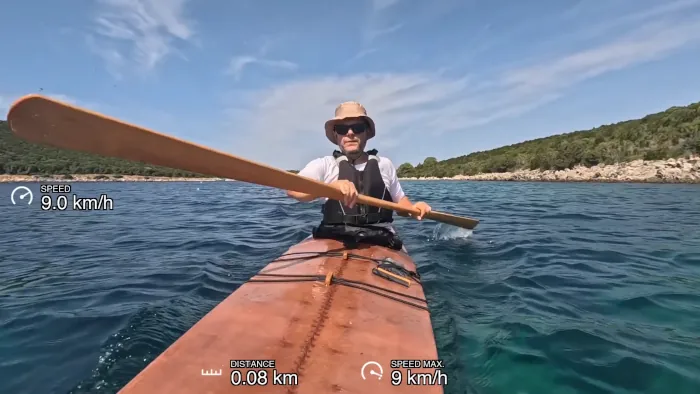
I’m testing here my West Greenland kayak which has LOA 520cm and beam 51cm.
The paddle that I’m using is a Greenland paddle that I built for myself, 215cm long and 8.2cm blade width.
I tried to get a no-wind scenario for my top speed tests, but that was practically impossible during my time at sea, so I tested my top speed upwind and downwind. Wind was 10 knots or slightly stronger at crosswind tests, but I found slightly calmer conditions near the shore and I’ve done upwind/downwind tests there.
The telemetry data shown in the video is extracted from GoPro GPS telemetry records.
I’m really sorry for amplified sounds from my camera, but working GoPro in a protective housing is much better than a dead one, trust me. Let me know if there is some better solution!
Speed
Top speed
I would say not too much over 10km/h. Downwind peak was 11.2 km/h and upwind 9.1km/h. I included a small video part of me paddling on a local lake with similar results (with slight wind in my back).
As I already wrote in my recent West Greenland Kayak Update blog, this type of hull is not designed for top speed but rather cruising efficiency, and these results are something that I expected and I’m actually quite satisfied with it.
With a highly experienced, stronger paddler (I’m far from this category) and a paddle with more power, this number would increase for certain, but I feel that I slightly started hitting the hull speed by producing more bow waves (it can be seen on the lake paddling part) than actual speed at 10 km/h.
Physics says something about wetted surface area, or the surface of a kayak that is in contact with the water, creating drag. Because of this, to reach higher top speed you would need to have a rounded hull (less wetted surface), which is also less stable. Trade-offs.
Acceleration
Although not so important for me, something you can feel is its nice acceleration.
Some factors responsible for that would be kayak shape, LOA/small beam, and its weight (13 kg).
Crosswind, tracking and weathercocking
I’m using here a slightly stronger upwind stroke while finishing it more toward the stern. It would be easier if I edged more to the upwind side, but I paddled a short distance. A nice Greenland technique is to shift your hands a little bit toward the downwind blade so you get a longer lever on the upwind side.
I would say the tracking is nice and reasonably good, but not perfect. If I had done some modifications in order to additionally prevent this, this would not be a Greenland kayak anymore. But zero rocker at the stern was present on some of these historical kayaks examples and I like it!
This is probably the main thing I was thinking about during finding the kayak I like, and it can be seen in my previous blogs. The thing is that Greenlanders were master builders and they knew exactly what they wanted from their kayaks. Weathercocking was not an issue for them, but a feature and a good hunting position. They needed to approach the seal going upwind; otherwise, it would more easily detect their scent or sound. Once they switched to harpoon throwing (while the kayak is still in movement), the kayak would maintain its direction, being less visible to the seal, and it would have maximum wave stability during harpoon throwing. That’s why most of these kayaks had a distinct rocker. Although tied-on skegs were present, and I believed they used them on the way back home if required. Additionally, if you look at Harvey Golden’s *Kayaks of Greenland*, they were used mostly later on rifle hunting kayaks, where the hunter required more time to aim at the prey, as weathercocking happens only while the kayak is moving forward. So they needed it in order to retain the line while aiming.
Cruising speed
Depending on paddler skills and strength, a cruising speed of 6-8 km/h can be achieved without a problem if you have some experience. This hull type offers excellent cruising efficiency while requiring minimal effort.
You may see my wife paddling with me at a speed of 5 km/h and she is in my test kayak: same West Greenland hull but with a keyhole cockpit coaming. The kayak is 520cm long and its beam is 53cm. It’s her 5th time sitting inside a kayak, and only in this kayak. No capsizes yet ;)
Edge turning
Although I still need to improve my technique, I tried to turn it with bow rudder and stern; the more you exclude the keel, the nicer turn you get. Fine for me. :)
More on stability
Taking photos, having a snack or a drink—the Greenland paddle is your friend! Use it as an outrigger and you’ll get more stability.
Regarding primary stability: having a flat hull on one side and a rounded hull on another, a V-type hull (shallow V at the sitting position, with a lower sitting position) is much closer to a flat hull than a rounded hull. However, people paddling flatter hulls will need a small transition period to feel comfortable in it. The flatter the hull, the more skeg you need. Trade-offs. I like minimalistic and light craft.
Bigger waves
I didn’t get very big waves, and I really wanted some, maybe next time! I’ll soon upload a video of towing my wife’s kayak from Ilovik to Lošinj, where I’m going mostly upwind in a 15–20 knot wind. Even though the waves weren’t too large, the kayak held up nicely. The raised bow and bow rocker performed great, while a few slightly bigger waves did put some water on the deck, I didn’t notice the bow diving into any waves.
The wave I caught in this video is a bit larger — it came from a powerboat. Weeeeeeee!
Update:
My new blog post on how I’m towing a West Greenland kayak: West Greenland Kayak towing
Rolling
It’s more about knowing how to roll than having a rolling kayak, but a lower-volume kayak will help for sure. Here I’m doing my best: balance brace, chest sculling, and reverse sweep roll. :)
P.S.
Yes I know, I need to improve my GP ‘canted’ stroke ;)
Special Thanks:
Mr. Ivica Ranogajec — the man who helped me with my first balance brace so I didn’t have to wet exit all the time. He’s also the photographer behind many of the photos on my website, and someone who has probably logged more kilometers on the water than on the road!
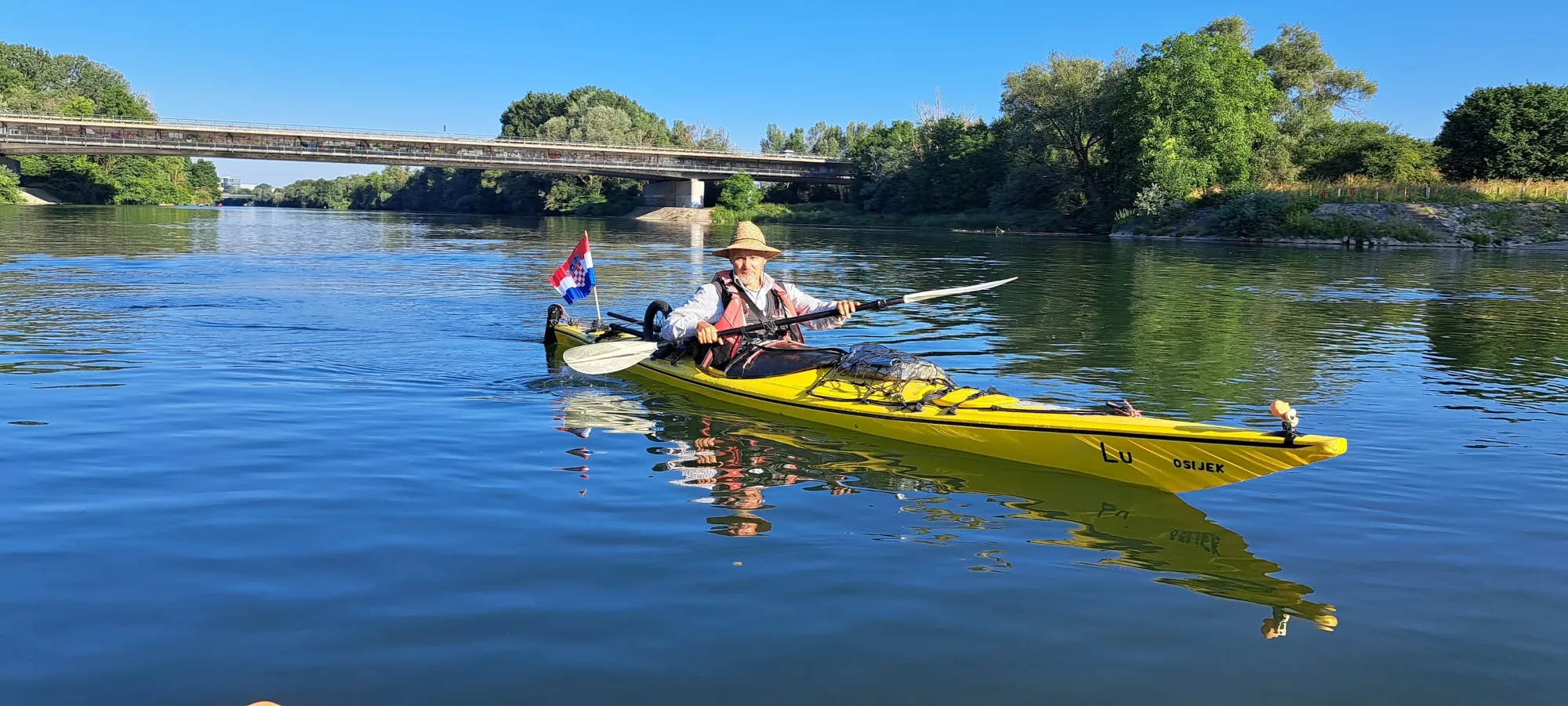
gpx2video — a fantastic open-source tool for displaying telemetry data on video, especially since the GoPro app doesn’t run natively on Linux.